 Skip-the-line available
 Würzburg, the Residence & the Romantic Road
A practical itinerary that pairs the Residence and its Tiepolo staircase with Marienberg Fortress, the Old Main Bridge and Franconia's wine country.
The Residence is the reason most travellers come to Würzburg, but it sits at the heart of a compact, walkable city and the start of the Romantic Road. Here is how to build the day around it.
Start with the Residence, then let the city unfold
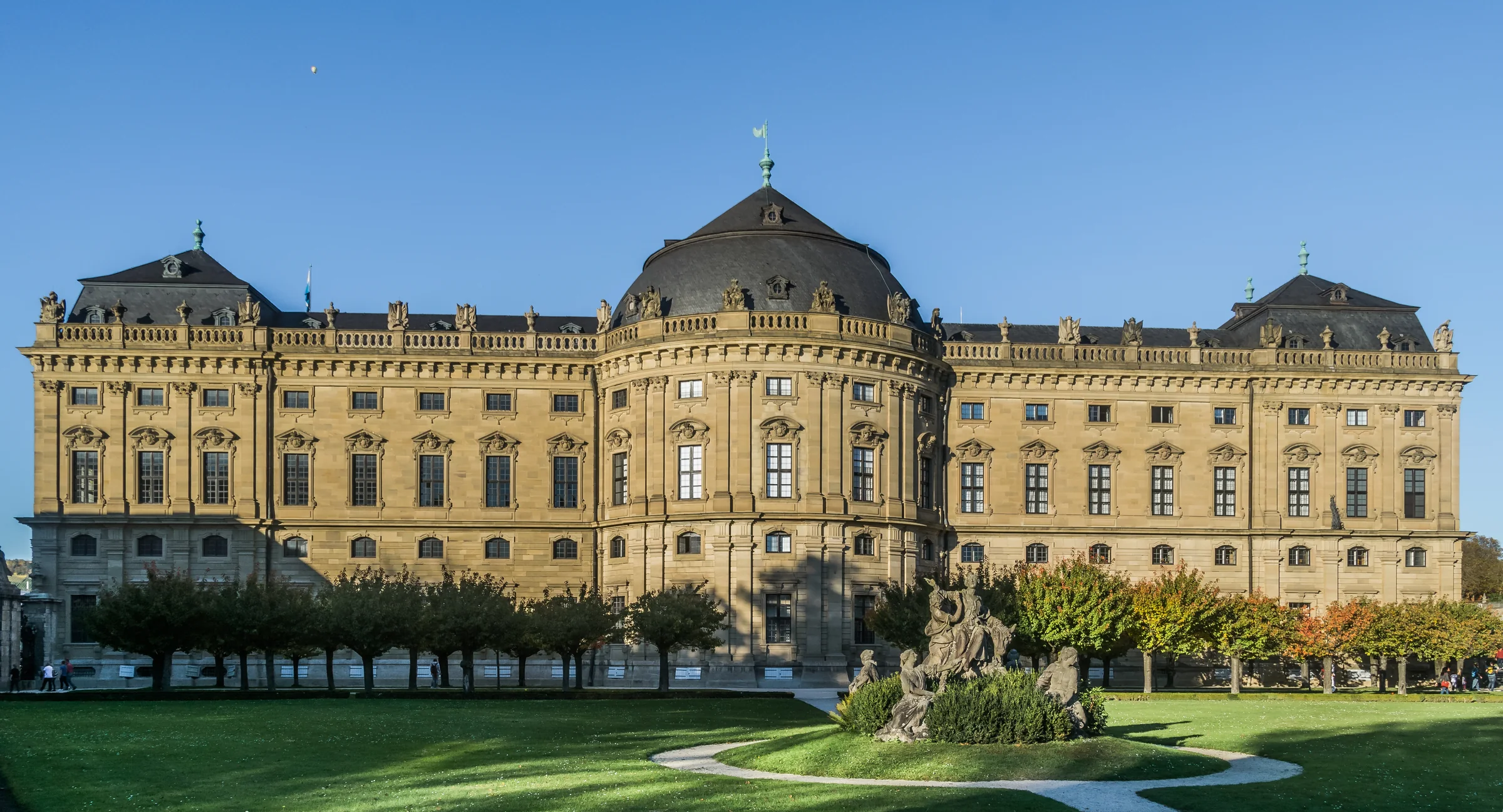
Give the palace the first, freshest hours of your day and everything else in Würzburg falls into place around it. The Residence is a UNESCO World Heritage Site and one of the most uniform Baroque palaces in Europe, built between 1720 and 1744 for the Prince-Bishops and shaped by Balthasar Neumann. Its centrepiece is the grand staircase, a single unsupported vault crowned by the largest ceiling fresco in the world, painted by Giovanni Battista Tiepolo in 1752 to 1753 and showing the Four Continents paying homage. From there the route runs through the White Hall, the rococo Imperial Hall with further Tiepolo work, and the Mirror Cabinet recreated from fragments after the 1945 bombing. Entry is date-based rather than a fixed timed slot, so you choose your day and arrive when it suits you. The main state rooms are seen self-guided at your own pace, while the Southern Rooms and certain apartments are shown only on guided tours that are included in the ticket and run at set times in German and English. Book your date-valid ticket ahead and print it at home to walk past the cash-desk queue on arrival. Practically, the palace deserves roughly one and a half to two hours before you factor in a guided tour, and it opens longer in the warmer half of the year, from around 09:00 to 18:00 April through October, with shorter winter hours. Once you step back out onto Residenzplatz, the free Court Garden lies directly behind the palace and the old town spreads downhill toward the river. Everything that follows in this guide is within a comfortable walk, which is exactly why Würzburg rewards a slow half-day rather than a rushed dash between stations. Anchor the morning here, keep your afternoon loose, and you will see the best of the city without hurrying a single room.
Marienberg Fortress and the view across the Main
Before the Prince-Bishops moved into the Baroque splendour of the Residence, they ruled from Marienberg Fortress, the great hilltop stronghold on the far bank of the Main. Crossing the river to reach it gives you the single best perspective on the city you have just explored: from the fortress terraces the rooftops, the cathedral towers and the Residence itself line up below you, with the vineyards climbing the slopes on either side. The walk up is part of the pleasure. From the Old Town you cross the river and climb through the Weinberge, the terraced vineyards that have clothed this hillside for centuries, on paths that reward every switchback with a wider view. The fortress has guarded Würzburg since the Middle Ages, was expanded into a Renaissance and Baroque stronghold, and today houses museum collections devoted to Franconian art and the region's history, so there is substance inside as well as the panorama outside. Pairing Marienberg with the Residence tells the whole story of the Prince-Bishops in a single day: the fortified medieval and Renaissance seat on the heights, and the confident, open Baroque palace they built once the city below no longer needed defending. It is a satisfying piece of narrative geography, and the contrast between the two buildings is genuinely instructive rather than merely scenic. Allow a good part of an afternoon if you want to climb up, look through the collections and linger over the view, or treat it as a shorter sunset detour if your legs have already carried you around the old town. Because the fortress sits above the wine terraces, it also sets up the afternoon's other pleasure perfectly, delivering you back down to the riverbank and the bridge where Würzburg does its evening drinking. Check current museum days and hours locally, as they vary by season.
The Old Main Bridge and the Brückenschoppen
No visit to Würzburg is complete without time on the Alte Mainbrücke, the Old Main Bridge that has linked the two banks since the fifteenth century. It is a pedestrian bridge now, lined on both parapets with tall Baroque statues of saints added in the eighteenth century, among them Kilian, the patron of Franconia, and John of Nepomuk. Walking its length puts the water below you, Marienberg Fortress rising ahead and the towers of the old town behind, which makes it the natural hinge between the two halves of a day spent crossing the river. The bridge is also home to one of the city's best-loved rituals, the Brückenschoppen. In the late afternoon and early evening, locals and visitors gather along the parapets with a Schoppen, a glass of Franconian wine, bought from the small wine bars at either end. People stand shoulder to shoulder in the low sun, glass in hand, watching the river and the fortress catch the light. It is unhurried, sociable and entirely characteristic of Franconian wine culture, and it costs nothing to join beyond the price of a glass. Time your day so the bridge comes late: the Residence in the morning, Marienberg and the vineyard walk through the afternoon, then the bridge as the light softens. Franconia's signature grape is the dry Silvaner, traditionally poured here and often bottled in the distinctive flat, rounded Bocksbeutel, so a Brückenschoppen doubles as a first taste of the region's wine country. If you would rather sit, the streets running back from the bridge into the old town are full of taverns and wine cellars where the same wines are served with hearty Franconian cooking. But the bridge itself, standing among the saints with a glass and the fortress glowing across the Main, is the moment most people remember, and it needs no reservation, only good timing and a little patience for the crowd.
The Cathedral, Market Square and Marienkapelle
Between the Residence and the river lies a genuinely compact old town, and its landmarks can be strung together in a single easy loop on foot. Würzburg Cathedral, dedicated to Saint Kilian, is one of the largest Romanesque churches in Germany, its long twin-towered silhouette a fixed point in the skyline you saw from the fortress. Inside, centuries of monuments to the Prince-Bishops line the nave, several of them fine Renaissance and Baroque sculptures, so the cathedral quietly continues the same story of church and princely power that the Residence tells so grandly. A few minutes away, the Market Square is the everyday heart of the city, busy with stalls and cafés and framed by tall gabled houses. Its showpiece is the Marienkapelle, a soaring late-Gothic church in warm red and white stone, richly ornamented and quite different in mood from the Romanesque cathedral or the Baroque palace, which makes the short walk between them a compressed tour through Würzburg's architectural centuries. Around these two churches the lanes are lined with shops, bakeries and wine taverns, and it is here that most people naturally pause for lunch between the Residence in the morning and the river in the afternoon. Because the distances are so small, you can fold the cathedral, the square and the chapel into perhaps an hour or ninety minutes of gentle wandering, longer if you stop to eat or step inside for a proper look. There is no need to plan a rigid route; the streets funnel you between the landmarks almost automatically, and every corner opens onto another gable, fountain or church front worth a photograph. Treat this cluster as the connective tissue of your day, the part that ties the palace on the hill to the bridge on the water, and Würzburg starts to feel less like a checklist of sights and more like a small, coherent city you have come to know on foot. Confirm any opening times for the churches on the day, as services and seasons affect access.
Franconian wine and the palace's own cellar
Würzburg is a wine city as much as an art city, and the two are not separate stories. The steep terraced slopes you climbed toward Marienberg are working vineyards, and the most famous of them, the great Würzburger Stein hillside above the city, has produced Franconian wine for many centuries. The region's calling card is dry Silvaner, crisp and food-friendly, along with Riesling and Müller-Thurgau, and much of it is still sold in the flat, rounded Bocksbeutel bottle that instantly marks a wine as Franconian. This is the wine you drink at a Brückenschoppen on the bridge and in the taverns of the old town, so tasting it is woven naturally through the day rather than being a separate excursion. The palace itself belongs to this tradition. Beneath the Residence run historic wine cellars, a reminder that the Prince-Bishops were great landowners whose estates included some of the finest vineyards in Franconia, and that wine was part of the wealth that paid for the frescoes upstairs. Standing in the state rooms and then thinking of the barrels stored below gives the whole complex a very human, very Franconian grounding: this was a court that lived well, and its wealth grew on the same slopes that still ripen grapes today. For travellers this means the region's wine culture is something you can taste within a short walk of the palace door, whether that is a glass on the Old Main Bridge, a bottle over dinner in an old-town tavern, or a visit to one of the traditional cellars that pour Franconian wine in the city. If your itinerary stretches to a second day, the vineyards of the surrounding countryside make an easy and rewarding extension, but even a single afternoon lets you connect the art on the ceilings with the wine in the glass, which is the most authentic way to understand what made Würzburg rich and what still makes it a pleasure to linger in after the sights close.
Würzburg: gateway to the Romantic Road
Würzburg is not only a destination in its own right; it is the northern gateway to the Romantic Road, the celebrated touring route that threads south through Bavaria toward the Alps. That position makes the city a natural first or last stop on a longer trip, and it means the Residence is often the grand opening chapter of a journey through walled medieval towns, castles and countryside. The most famous stop just down the road is Rothenburg ob der Tauber, the almost perfectly preserved medieval town whose ramparts, towers and cobbled lanes have made it one of Germany's most photographed places. Beyond it the route continues through further historic towns and rolling landscapes, but Rothenburg is the classic day-trip or overnight pairing with Würzburg and the two together give a satisfying contrast: high Baroque court art in the city, intact medieval streetscape a short journey south. Because Würzburg is so well connected by rail and road, it works equally well as the place you arrive, see the Residence, and then set off down the Romantic Road, or as the polished finale after days among the smaller towns. If you are building a multi-day trip, start with the palace while your energy is highest, give Würzburg a full day of its own using the itinerary in this guide, then continue south with the city's art and wine fresh in mind. Even if the Romantic Road is not part of your plans, knowing that Würzburg sits at its head helps explain the city's character: this has long been a place travellers pass through and pause in, a confident regional capital used to welcoming visitors and sending them onward. For most people the practical takeaway is simple. Treat the Residence as the anchor, give Würzburg itself the time it deserves, and let the Romantic Road be the tempting next step rather than a reason to rush the palace on your first morning in Franconia.
One day or two: plans and getting there
For a single day, keep it to a tight loop. Start at the Residence when it opens, book your date-valid ticket ahead and print it at home so you skip the cash-desk queue, and give the state rooms and one included guided tour the best part of two hours. Step out to the free Court Garden, walk downhill into the old town for the cathedral, the Market Square and the Marienkapelle, and pause there for lunch. In the afternoon cross the Old Main Bridge, climb toward Marienberg Fortress for the view back over the city, then come down to the bridge again for a Brückenschoppen as the light softens. That sequence sees the essentials without hurrying the palace. With two days, spread the same ground more gently and add depth. Day one is the Residence, the Court Garden and the old-town churches at an unhurried pace, finishing with wine on the bridge. Day two gives Marienberg Fortress and its museums a proper morning, leaves the afternoon for the vineyards and a traditional Franconian cellar, or takes the short trip south to Rothenburg ob der Tauber for a taste of the Romantic Road. Getting to Würzburg is easy. It is about one hour by fast train from Frankfurt and roughly two hours from Munich or Nuremberg, which makes it a realistic day trip as well as a stop on a longer route. From Würzburg Hauptbahnhof the Residence is a walk of about fifteen to twenty minutes, or a short tram ride, and the address is Residenzplatz 2 in the city centre. Remember that entry is valid on your chosen date rather than a fixed timed slot, that under-18s enter free and students over 18 enter free with valid ID, and that under-14s must be accompanied by an adult. Reduced tickets require original proof of eligibility on site. Book ahead, arrive early, and let the rest of Würzburg unfold at walking pace from the palace door.
Frequently asked
How much time should I plan for the Würzburg Residence?
Allow roughly one and a half to two hours for the palace. The main state rooms, including the Tiepolo staircase, the White Hall and the Imperial Hall, are seen self-guided at your own pace. Add time if you join one of the included guided tours of the Southern Rooms, which run at set times in German and English.
Can I see the Residence and Marienberg Fortress in one day?
Yes, comfortably. Start at the Residence in the morning, walk through the old town for lunch, then cross the Old Main Bridge and climb to Marienberg Fortress in the afternoon for the view back over the city. Finish with a glass of Franconian wine on the bridge as the light softens.
Is Würzburg a good base for the Romantic Road?
Very much so. Würzburg is the northern gateway to the Romantic Road, so it makes a natural first or last stop. Rothenburg ob der Tauber, the famous walled medieval town, lies a short trip south and pairs beautifully with a day spent on the Residence and the rest of the city.
How do I get to Würzburg and the Residence?
Würzburg is about one hour by fast train from Frankfurt and roughly two hours from Munich or Nuremberg. From Würzburg Hauptbahnhof the Residence, at Residenzplatz 2 in the city centre, is a walk of about fifteen to twenty minutes, or a short tram ride.
Do I need to book Residence tickets ahead, and do children pay?
Booking ahead and printing your ticket at home lets you skip the cash-desk queue. Entry is valid on your chosen date rather than a fixed timed slot. Under-18s enter free and students over 18 enter free with valid ID; under-14s must be accompanied by an adult. Reduced tickets need original proof on site.