 Skip-the-line available
 Visiting the Würzburg Residence: A Practical Guide
Everything you need to plan a smooth visit to Balthasar Neumann's Baroque masterpiece — seasonal hours, the quietest times, what to see, and how to arrive.
The Würzburg Residence rewards a little planning. Knowing the seasonal hours, the quietest hour to arrive, and which rooms are self-guided lets you spend your time under the frescoes rather than in a queue.
When the Residence Is Open
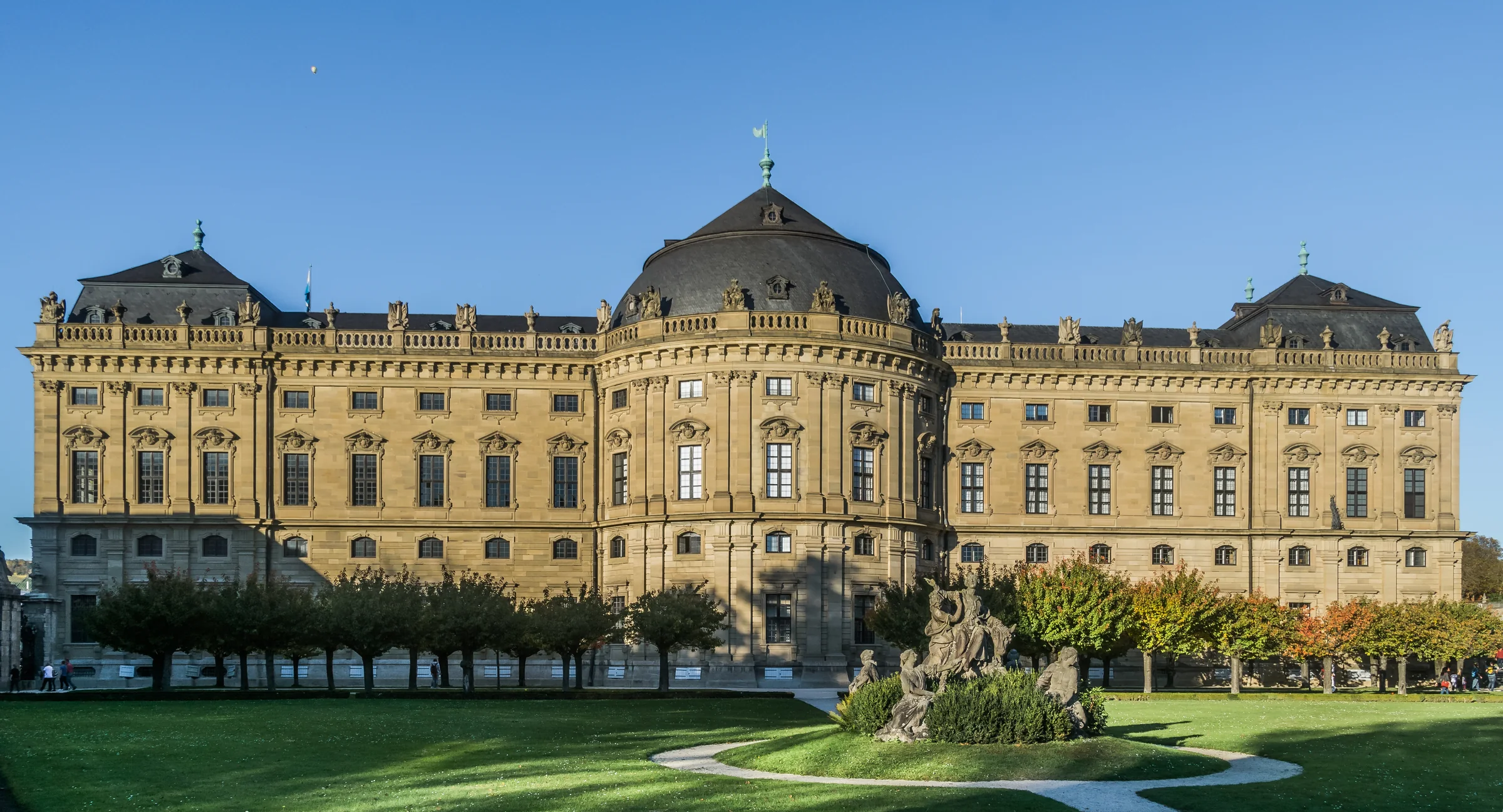
The Residence keeps two seasonal timetables, and knowing which one applies to your trip is the single most useful thing to check before you travel. From April to October the palace runs its long summer hours, opening at roughly 09:00 and admitting visitors until around 18:00, with last admission about 17:30. That generous window is ideal for combining the state rooms with an unhurried walk through the Court Garden afterwards, since the light in the later afternoon falls beautifully across the Baroque façade and the parterres behind it. From November to March the palace shifts to shorter winter hours, opening around 10:00 and closing near 16:30, with last admission about 16:00. In the colder months the days are short and the interior lighting becomes part of the experience, so an earlier start leaves more room to linger. Because a Baroque interior of this scale takes time to walk properly, always aim to arrive well before the last-admission time rather than on the hour it closes; arriving thirty minutes before the doors shut rarely leaves enough time to do the rooms justice. The Residence is closed on a small number of public holidays, which typically include 1 January, Shrove Tuesday, and 24, 25 and 31 December. These dates shift slightly from year to year and the seasonal changeover can move by a week or two, so treat the times above as a reliable guide rather than a fixed contract, and confirm the exact hours for your chosen date when you book. Entry to your ticket is valid for the date you select rather than a fixed minute of arrival, which gives you welcome flexibility: if your morning train runs late or lunch overruns, you simply arrive later the same day and walk in, without forfeiting your visit or rebooking a slot.
The Best Time to Visit
For the calmest experience, arrive in the first hour after opening. The staircase hall and the grand state rooms are at their quietest in the morning, before coach groups and school parties reach the city centre, and standing beneath Tiepolo's ceiling with only a handful of other visitors is a very different thing from sharing it with a full room. Mornings also tend to bring the softest natural light through the tall windows, which flatters the white stucco of the ceremonial halls and the gilded detail of the smaller cabinets. If a morning is impossible, the late afternoon in summer is the next-best window; by then the mid-day peak has thinned and many day-trippers have moved on to lunch or the riverside wine bars, leaving the rooms noticeably less crowded than they are around noon. Weekdays are generally quieter than weekends throughout the year, and the shoulder seasons of late spring and early autumn strike the happiest balance of pleasant weather, open gardens, and manageable numbers. High summer and school holidays are the busiest stretches, and while the palace never feels frantic in the way a major city museum can, the difference between a Tuesday in May and a Saturday in August is real. Weather matters too, because rain pushes everyone indoors at once; on a wet afternoon the state rooms fill more quickly than the timetable alone would suggest. If your schedule is fixed and lands on a busy day, don't be discouraged — the interior absorbs visitors well and the self-guided route keeps people moving. Booking your ticket ahead simply removes the cash-desk queue from the equation, so whatever hour you choose, you walk past the ticket line and straight toward the staircase rather than waiting to pay before you can even begin.
How Long to Allow
Set aside about an hour and a half to two hours for the state rooms, and more if you want to include the Court Garden. That range suits most visitors: an hour and a half is comfortable if you move at a steady pace and read a handful of the room descriptions, while two hours lets you slow down at the staircase, the Imperial Hall and the Mirror Cabinet without feeling you are being swept along. Anyone with a real appetite for Baroque architecture, ceiling painting or the history of the reconstruction could happily spend longer still, doubling back to the staircase to see the fresco again from the upper landing, where the Four Continents read quite differently than they do from below. The Court Garden behind the palace deserves its own slice of time and is a pleasure in its own right, so add anywhere from thirty minutes to an hour if the weather is kind and you want to stroll the terraces and clipped hedges. Families with children often find that a slightly brisker circuit of the interior followed by open space in the garden works best, giving younger visitors room to move after the hush of the state rooms. If you plan to catch one of the included guided tours of the further rooms, factor that in as well, since those run at set times and add perhaps three-quarters of an hour to your visit. As a simple rule of thumb, block out a clear half-day if you intend to see everything at leisure and pair it with the free Court Church and garden, or a focused two hours if you are threading the Residence into a fuller day of sightseeing around Würzburg. Either way, arriving with time in hand is far more enjoyable than racing the closing bell.
What You'll See Inside
The visit begins with the room that made the palace famous. Balthasar Neumann's grand staircase rises in a single unsupported vault, and that vault carries the largest ceiling fresco in the world, painted by Giovanni Battista Tiepolo in 1752–53. The fresco stages the Four Continents — Europe, Asia, Africa and America — paying homage, and it repays a slow ascent: details resolve as you climb, and the whole composition changes character between the lower flight and the upper landing. From the staircase the route opens into the ceremonial heart of the palace. The White Hall (Weißer Saal) is a cool, theatrical room of white rococo stucco by Antonio Bossi, deliberately restrained so that it acts as a pause between the colour of the staircase and the splendour beyond. That splendour is the Imperial Hall (Kaisersaal), the ceremonial climax, where further frescoes by Tiepolo crown a room of marble, gilding and illusionistic architecture. Elsewhere you will find the Mirror Cabinet (Spiegelkabinett), an intimate jewel of a room whose glittering surfaces were painstakingly recreated from surviving fragments and old photographs after the war — one of the most moving results of the palace's long reconstruction. Two further spaces are always free to enter and well worth your time: the Court Church (Hofkirche), a compact Baroque chapel of astonishing richness for its size, and the Court Garden (Hofgarten) behind the palace, with its terraces, sculpture and clipped greenery. It is worth remembering as you walk that almost all of this was gutted by fire in March 1945; Neumann's staircase vault and the Tiepolo fresco above it survived, and the state rooms you see today are the fruit of decades of exacting restoration. Knowing that history gives the gleaming interiors an added weight — you are looking at both an eighteenth-century masterpiece and a twentieth-century act of recovery.
Self-Guided Rooms and the Included Guided Tours
It helps to understand, before you arrive, how the palace is actually experienced, because it works in two ways. The main state rooms — the staircase beneath the Tiepolo fresco, the White Hall and the Imperial Hall — are seen self-guided, at your own pace. There is no fixed marching order and no guide to keep step with; you move through the great ceremonial sequence as slowly or as briskly as you like, pausing where a room holds you and pressing on where it doesn't. For most visitors this is the bulk of the visit and the part that lingers in memory. Some further rooms, however, can only be seen on guided tours. These include the Southern Rooms (Südräume) and certain other apartments, and the tours are included in your ticket rather than an extra purchase. They run at set times through the day and are offered in German and English, so if seeing these rooms matters to you, it is worth checking the day's tour times when you arrive and planning your self-guided circuit around one of them. This is an honest point worth being clear about: your ticket does not grant a private, walk-in-any-second pass to every space in the palace. The headline rooms are yours to explore freely, while the guided-only rooms are gathered up at scheduled moments and shown as a group. In practice the two dovetail well. Many visitors do the self-guided state rooms first, join a guided tour of the further apartments when its time comes around, and finish in the free Court Church and Court Garden. If you are short on time and the guided rooms are not your priority, you can simply enjoy the self-guided sequence — the staircase, the White Hall and the Imperial Hall alone justify the trip, and no tour is required to stand under the great fresco.
Photography, Cloakrooms and Accessibility
A few practical norms make the visit smoother. As in most historic palaces of this rank, larger bags and rucksacks are generally not carried through the state rooms, both to protect the interiors and to keep the narrow doorways and stair flights clear; expect to leave bulkier items in a cloakroom or locker near the entrance before you begin, and travel through the rooms with only what you need. Photography rules in palaces like this are typically stricter than in a public museum, and flash and tripods are the usual sticking points because flash is harmful to painted and gilded surfaces over time. The sensible approach is to look for the posted guidance at the entrance and to follow any direction given inside rather than assuming; if in doubt, put the camera away and simply look, because the staircase fresco in particular is better experienced with the naked eye than through a screen. Accessibility is a genuine consideration in a building of this age, since the ceremonial route is built around Neumann's great staircase and the palace was never designed with level access in mind. Step-free routes and assistance can be limited in parts of a historic structure like this, so if anyone in your party has reduced mobility it is well worth checking the current access arrangements for your date in advance rather than discovering constraints on the day. Comfortable shoes make a real difference given the amount of walking and the hard stone floors, and there is no cloakroom substitute for dressing for the season — the interiors can feel cool even in summer. The free Court Garden behind the palace offers flat, open paths and benches where anyone who needs a rest can pause, and it makes a gentle, restorative end to the visit once the concentrated splendour of the state rooms is behind you.
Getting to the Residence
The Residence stands at Residenzplatz 2, right in the centre of Würzburg, which makes it an easy addition to a day in the city or a stop on a longer Franconian itinerary. From Würzburg Hauptbahnhof, the main railway station, it is roughly a fifteen- to twenty-minute walk through the old town, a pleasant approach that brings you past shops and squares before the palace opens out in front of you across its forecourt. If you would rather not walk, a short tram ride covers most of the distance and drops you close by. Würzburg is exceptionally well connected by rail, which makes the Residence a realistic day trip: fast trains reach the city in about an hour from Frankfurt, and in roughly two hours from either Munich or Nuremberg, so a mid-morning departure leaves ample time for the state rooms and the garden before an afternoon return. Drivers should bear in mind that the city centre is compact and historic, so it is usually easier to use a car park on the approach and continue on foot than to hunt for space beside the palace itself. Once you are there, the Residence sits within comfortable reach of everything that makes Würzburg worth lingering over. The city marks the northern start of the Romantic Road, and within a short walk you will find the Old Main Bridge (Alte Mainbrücke), lined with statues and famous for the Franconian wine bars where locals gather with a glass in the evening light, as well as the Würzburg Cathedral. Across the river, the Marienberg Fortress looks down over the vineyards that ring the town. Pairing the palace with a stroll over the bridge and a glass of the local Silvaner turns a focused visit into a full and memorable day.
Frequently asked
What are the opening hours of the Würzburg Residence?
Hours are seasonal. From April to October the palace opens roughly 09:00 to 18:00, with last admission about 17:30. From November to March it opens around 10:00 to 16:30, with last admission about 16:00. It closes on a few public holidays, so confirm the exact times for your chosen date.
How long should I plan to spend there?
Allow about one and a half to two hours for the self-guided state rooms, and add thirty minutes to an hour if you want to walk the free Court Garden. If you join one of the included guided tours of the further rooms, factor in roughly another three-quarters of an hour.
When is the quietest time to visit?
The first hour after opening is calmest, especially on weekdays, before groups reach the centre. Late afternoon in summer is the next-best window. Weekends and high summer are busiest, though the interior absorbs visitors well and the self-guided route keeps people moving throughout the day.
Can I see every room on my own, or are guided tours needed?
The main state rooms — the staircase under the Tiepolo fresco, the White Hall and the Imperial Hall — are self-guided at your own pace. Some further rooms, such as the Southern Rooms, are seen only on guided tours that are included in your ticket and run at set times in German and English.
How do I get to the Residence from the station?
The Residence is at Residenzplatz 2 in the city centre, about a fifteen- to twenty-minute walk from Würzburg Hauptbahnhof, or a short tram ride. Würzburg is roughly an hour by fast train from Frankfurt and about two hours from Munich or Nuremberg, making it an easy day trip.